The people who end up training for life are usually the ones who are the least likely to start.
They are not the naturally gifted or purely athletic types who pick things up immediately and feel at home right away. More often, they are the ones who had to push past feeling awkward, out of shape, intimidated, or unsure they belonged before they ever learned a technique.
That struggle at the beginning matters.
When someone has to overcome real barriers early on, they build grit fast. They learn how to be uncomfortable, how to fail in front of other people, how to keep showing up without any guarantee of success, and those habits turn out to be more important than talent.
On the other hand, the students who rely almost entirely on natural ability tend to have a different experience. Things come easily at first. Progress feels fast. For a while, it’s fun and effortless. But eventually everyone in Jiu Jitsu hits a wall. Techniques stop working on muscle alone. Timing, patience, and detail start to matter. That’s often where the drop‑off happens.
That’s a big reason turnover in Jiu Jitsu is so high.
Jiu Jitsu doesn’t respond well to shortcuts. It rewards consistent work and punishes ego. Natural ability can make a technique look better, cleaner, or faster, but it rarely overcomes poor fundamentals or a lack of dedication. In the long run, the mat doesn’t care how athletic you are. It only responds to what you’re willing to put into it.
Most people who would do well in training never go searching for it.
They don’t read martial arts blogs or watch technique breakdowns. They don’t see themselves as fighters or athletes. In their head, training is for someone else. Younger, tougher, more physically confident people. People who already know what they’re doing.
So they talk themselves out of trying because they’ve already decided they wouldn’t be good at it.
When those people do walk through the door, it’s often because someone they trust mentioned it casually, or sent them something to read.
Once they get on the mat, most of what they feared turns out not to matter.
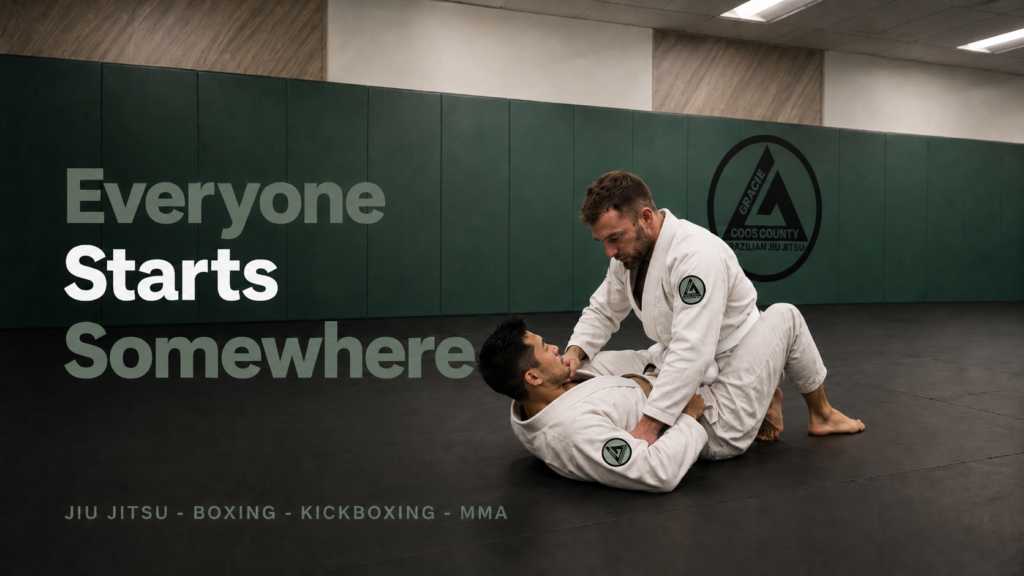
Training doesn’t look like what people imagine. It isn’t a room full of aggression or judgment. It’s people learning, struggling, asking questions, getting things wrong, and trying again. Nobody skips being a beginner. Everyone earns their place by showing up and doing the work.
Over time, something changes. The movements get better and easier. They become harder to rattle. They stop panicking when something doesn’t work and learn to solve problems instead of avoiding it.
If you’re reading this, you are probably not the person it is really aimed at, but there is a good chance that someone came to mind while you were reading.
A friend who doesn’t think they’re athletic. A family member who believes they’re past their prime. Someone who would never click on a martial arts article but might listen to you.
If that’s the case, feel free to pass this along. Not as a challenge but as a reminder that the people who struggle at the beginning are often the ones who end up going the farthest.
Everyone starts somewhere. Gracie Coos County offers Jiu Jitsu, Boxing, Kickboxing and MMA. Grab a friend that would never try it on their own and come try two free lessons to see that it is for them!

